Long before astrology became a system of birth charts, houses, aspects, and transits, people looked at the sky and saw stories.
The planets were not simply objects moving through space. They became symbols of forces that human beings could recognize within themselves. Love, desire, fear, courage, ambition, loss, wisdom, transformation, and hope were reflected through planetary myths.
This is one of the reasons astrology still feels so alive today. The language may be ancient, but the experiences behind it are deeply human.
Each planet represents an archetype. Together, they tell the story of who we are, what we need, how we love, how we fight, what we fear, and how we grow.
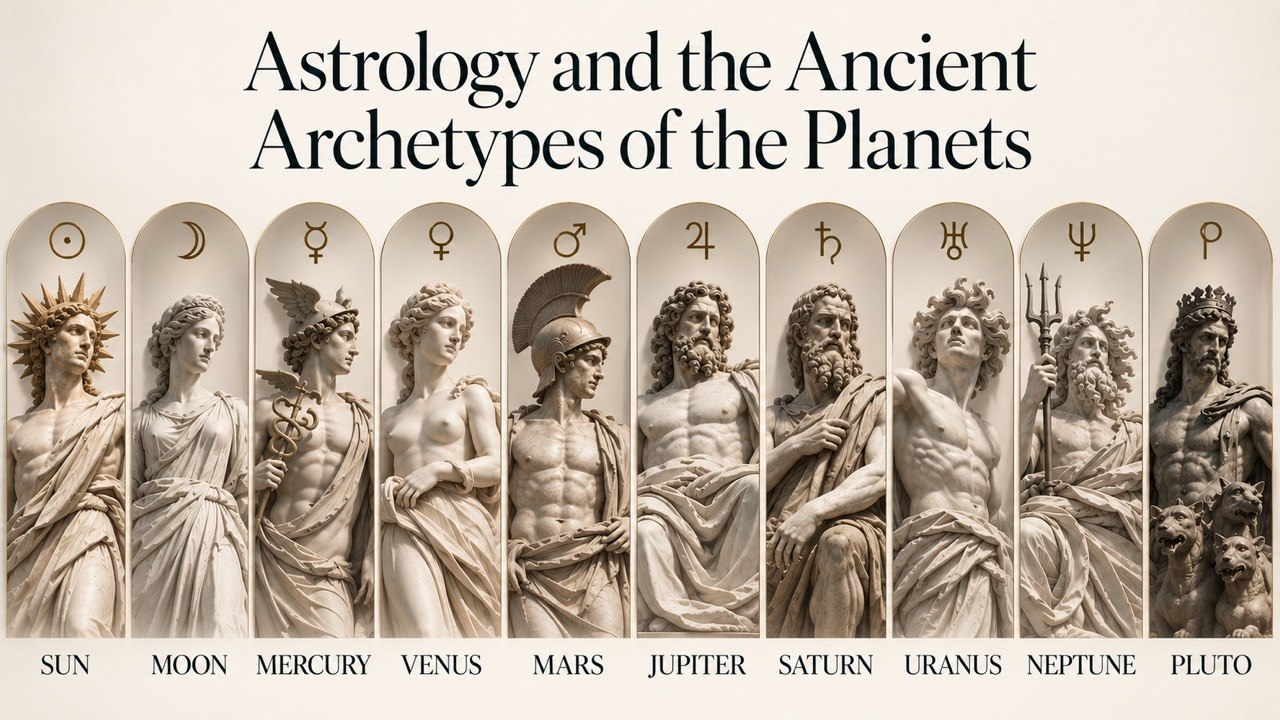
The Sun: The Sovereign
The Sun has always held a special place in human consciousness. Ancient cultures associated it with life, authority, illumination, vitality, and divine power.
In astrology, the Sun represents our sense of self. It speaks about identity, purpose, confidence, creativity, and the person we are gradually becoming.
I often think of the Sun as the part of us that wants to live consciously.
The Sun asks a simple but profound question.
Who am I when I allow myself to fully become myself?
This is why the Sun in a birth chart is not simply a description of personality. It can show a lifelong process of discovering and expressing who we truly are.
The Moon: The Mother
If the Sun represents consciousness, the Moon takes us into a much more private world.
For thousands of years, the Moon has been associated with fertility, motherhood, cycles, intuition, the body, and the mysteries of birth and death. Its changing phases made it a natural symbol for the changing rhythms of human life.
Astrologically, the Moon represents our emotional nature, instincts, memories, habits, and need for safety.
The Moon is the part of us that reacts before we have time to think. It tells us what feels like home. It also reveals what we need when we are vulnerable.
The Sun may ask, Who am I?
The Moon asks, What do I need in order to feel safe enough to be myself?
Mercury: The Messenger
Mercury is connected with Hermes, one of the most fascinating figures in Greek mythology.
Hermes was the messenger of the gods, but he was also a traveler, translator, trickster, merchant, and guide between different worlds. He could cross boundaries that others could not.
This symbolism beautifully reflects Mercury in astrology.
Mercury represents communication, thought, language, curiosity, perception, and learning. It shows how we process information and how we communicate what is happening inside us.
Mercury creates connections.
When Mercury interacts with Mars, words can become sharper and more direct. With Saturn, thinking may become careful and structured. With Neptune, the mind may communicate through imagination, intuition, poetry, and symbolism.
Mercury gives language to the rest of the chart.
Venus: The Lover
Venus carries the ancient archetype of Aphrodite, the goddess of beauty, attraction, pleasure, sexuality, and love.
But Venus is not only about romantic relationships.
Venus is about value.
What do you find beautiful? What attracts you? What makes you feel worthy? What kind of love are you able to receive? What are you naturally drawn toward?
Venus represents our relationship with pleasure, connection, harmony, beauty, and self worth.
She does not chase. She attracts.
This is where the relationship between Venus and Mars becomes especially interesting.
Venus represents what we desire. Mars gives us the courage to move toward it.
Mars: The Warrior
Mars represents one of our most instinctive archetypes.
Associated with the Roman Mars and the Greek Ares, Mars symbolizes courage, action, competition, anger, sexuality, survival, and desire.
Mars is the part of us that says, I want this.
It is also the part that knows how to say no.
Mars gives us the ability to defend ourselves, establish boundaries, take risks, compete, and act upon our desires.
Mars is not simply about anger or aggression. At its healthiest, Mars represents courage, initiative, and the willingness to act when something matters.
Without Mars, we may know what we want but never move toward it. Mars turns desire into action.
The relationship between Venus and Mars is especially important because Venus attracts while Mars pursues. Venus reveals what we value. Mars shows what we are willing to do to experience it.
Together, they describe an ancient dance between attraction and action.
Jupiter: The Teacher
Jupiter carries the archetype of Zeus in Greek mythology and Jupiter in Roman mythology, the powerful ruler of the gods.
In astrology, Jupiter represents expansion, wisdom, faith, opportunity, abundance, philosophy, and our search for meaning.
Jupiter wants us to look beyond what we already know.
It encourages exploration, education, travel, teaching, and the development of a larger understanding of life.
Where Jupiter appears in the birth chart, there is often a desire for growth. We want more experience, more knowledge, more possibility, and sometimes more freedom.
But Jupiter also reminds us that more is not always better.
Confidence can become arrogance. Optimism can become unrealistic. Expansion without awareness can become excess.
At its highest expression, Jupiter is not simply abundance. It is wisdom.
Jupiter asks us what gives our life meaning.
Saturn: The Elder
Saturn is one of the most misunderstood planetary archetypes.
Connected with the ancient figure of Cronus, Saturn represents time, responsibility, boundaries, discipline, authority, maturity, and consequence.
Saturn reminds us that life has limits.
We cannot have everything immediately. We cannot escape time. We cannot create something lasting without patience, effort, and responsibility.
This can make Saturn uncomfortable, but Saturn is not simply a symbol of hardship.
Saturn gives form to our lives.
Jupiter may give us a vision, but Saturn asks whether we are willing to build it. Venus may bring love, but Saturn asks whether we can commit. Mars may create ambition, but Saturn asks whether we can continue after the excitement disappears.
Saturn teaches us that maturity is not about having everything figured out. It is about developing the strength to stay present with what requires time.
Uranus: The Awakener
Uranus brings us into a different territory.
Named after the ancient sky god Ouranos, Uranus became associated in modern astrology with freedom, revolution, awakening, disruption, innovation, individuality, and sudden change.
Uranus does not tolerate stagnation easily.
Where Saturn creates structure, Uranus asks whether that structure still allows us to breathe.
Sometimes we remain inside relationships, careers, beliefs, identities, or lifestyles simply because they are familiar.
Uranus enters those places and asks a difficult question.
Is this still who you are?
Its changes can feel sudden because awakening is rarely convenient.
Uranus represents the part of us that needs enough freedom to become authentic.
Neptune: The Mystic
Neptune takes us into the world of dreams, spirituality, imagination, compassion, intuition, art, and mystery.
Named after the Roman god of the sea, Neptune carries the symbolism of the ocean, a place where boundaries become difficult to see.
In astrology, Neptune represents the places where the separation between ourselves and something greater begins to dissolve.
It can bring extraordinary creativity, sensitivity, empathy, imagination, and spiritual longing.
But Neptune also has a shadow.
When boundaries disappear, intuition can become projection. Dreams can become fantasy. Compassion can become self sacrifice. Spirituality can become an escape from reality.
Neptune teaches us that surrender and avoidance are not the same thing.
Its deeper invitation is to remain open to mystery while keeping our feet connected to reality.
Pluto: The Lord of the Underworld
Pluto takes us into the deepest layers of human experience.
Its name comes from the Roman god of the underworld, connected with the Greek Hades.
This mythology gives Pluto its association with death, rebirth, hidden power, taboo, obsession, destruction, and regeneration.
Pluto represents the experiences that change us at the root.
Sometimes an old identity must end. Sometimes emotions we have buried for years have to surface. Sometimes we have to confront fear, grief, jealousy, control, desire, or power before we understand how deeply they have shaped our lives.
Pluto takes us beneath appearances.
But Pluto is not only about destruction.
It is about regeneration.
There are moments when holding onto the past becomes more painful than allowing transformation to happen. Pluto represents that threshold.
Something ends, something is released, and eventually something new becomes possible.
The Planets in Relationship
The real beauty of astrology appears when we stop seeing the planets as separate characters.
A birth chart is a conversation between them.
The Sun wants to become.
The Moon wants to feel safe.
Mercury wants to understand.
Venus wants to connect.
Mars wants to act.
Jupiter wants to expand.
Saturn wants to build.
Uranus wants to liberate.
Neptune wants to transcend.
Pluto wants to transform.
Sometimes these parts of ourselves work beautifully together. Sometimes they want completely different things.
Venus may long for intimacy while Uranus needs freedom. Mars may want to act immediately while Saturn demands patience. Jupiter may believe that anything is possible while the Moon is afraid to leave what feels familiar. Mercury may want a rational explanation while Neptune experiences something that cannot easily be explained through logic.
These contradictions are not flaws in the birth chart.
They are part of what makes us human.
Astrology gives us a language for understanding these different voices within ourselves.
Perhaps this is why the ancient planetary archetypes remain meaningful even in the modern world.
The gods belong to ancient stories, but the experiences they represent are still happening every day.
We still love through Venus.
We still desire and fight through Mars.
We search for meaning through Jupiter.
We meet our limitations through Saturn.
Uranus awakens us.
Neptune makes us dream.
Pluto transforms us.
Mercury helps us understand the story.
The Moon reminds us what we need.
And through all of it, the Sun continues asking one of the oldest and most important questions of all.
Who are you becoming?
More Posts